
Here are excerpts with links to just a few of the stories I’ve written over lots of years. I was a journalist, always partisan: an editor for Southern Exposure, a social justice magazine, at In These Times, a lefty newsmagazine, for Now & Then, an Appalachian magazine and others. More recently, I’ve been an activist in my Lower East Side neighborhood.
New York
Save East River Park
East River Park ACTION
Mayor Bill de Blasio’s administration announced in 2018 that it was going to raze the big riverfront park in my neighborhood of the Lower East Side. An eight-foot levee would be installed and a new park put on top—eventually. A lot of residents objected, but not loudly enough, I thought. One night I furiously created a website. i showed it to a few friends in the neighborhood who were also frustrated by the city’s stubborn insistence on destroying the park. That inspired creation of a community group to agitate loudly for a less destructive flood control plan. Here’s the website I still maintain, East River Park Action.
Even as we involved thousands of community residents, I assumed saving the park was lost cause. It was such an environmentally disastrous plan—for the earth and our neighborhood–that we had to protest. After three years of protests, petitions, lawsuits and pleas, on Dec. 7, 2021, the city started demolishing the park.
The protests go on, but I am a weary activist and stepped away from the frontlines. Many carry on the important work to try to protect public health, gain meaningful alternative park spaces and to hold public officials responsible for this miserable, unjust project. Others are still trying to save the sections that haven’t yet been bulldozed. Here are excerpts from some of the editorials l wrote. Click on the links to read the full story:
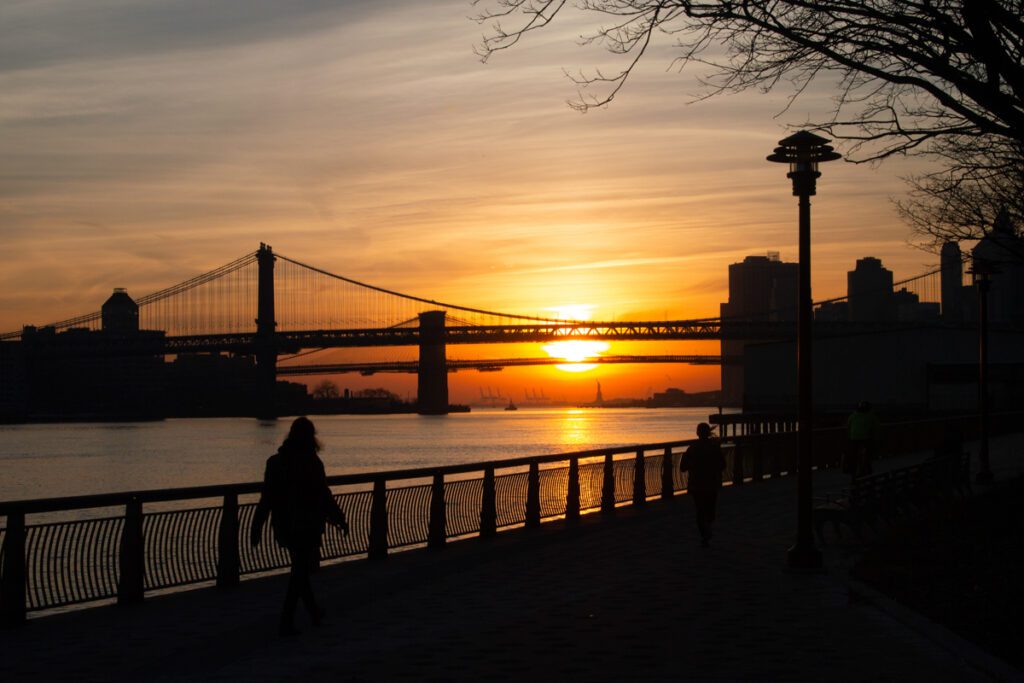
I like to think the campaign to save East River Park had meaning. I took heart from this: “…real courage is… when you know you’re licked before you begin but you begin anyway and you see it through no matter what.”
from To Kill a Mockingbird by Harper Lee
Opinion: Carlina Rivera… A view from the Lower East Side of a District 10 candidate
BY PAT ARNOW, JULY 29, 2022, THE VILLAGE SUN
East River Park was a much-used 1.2-mile-long waterfront oasis in a densely populated, modest part of Manhattan. Now most of the park is a vast dirt pile, demolished for an ill-advised flood-control project that will put a massive levee along the river.
Carlina Rivera pushed through the plan’s approval in the City Council despite widespread and sustained community opposition. Rivera ignored alternative solutions. Now that the project is underway, she has failed to demand meaningful oversight or accountability from the contractors or the city…
Losing our park unnecessarily is not the only reason to beware of this candidate.
Look at Carlina Rivera’s non-answer to a District 10 candidate questionnaire: Would she take real estate donations? “I have committed to vetting individuals and have pledged to not take fossil fuel, defense company or pharmaceutical monies.”
(Rivera does take real estate money and a lot of it.) Click here to read the full op-ed.
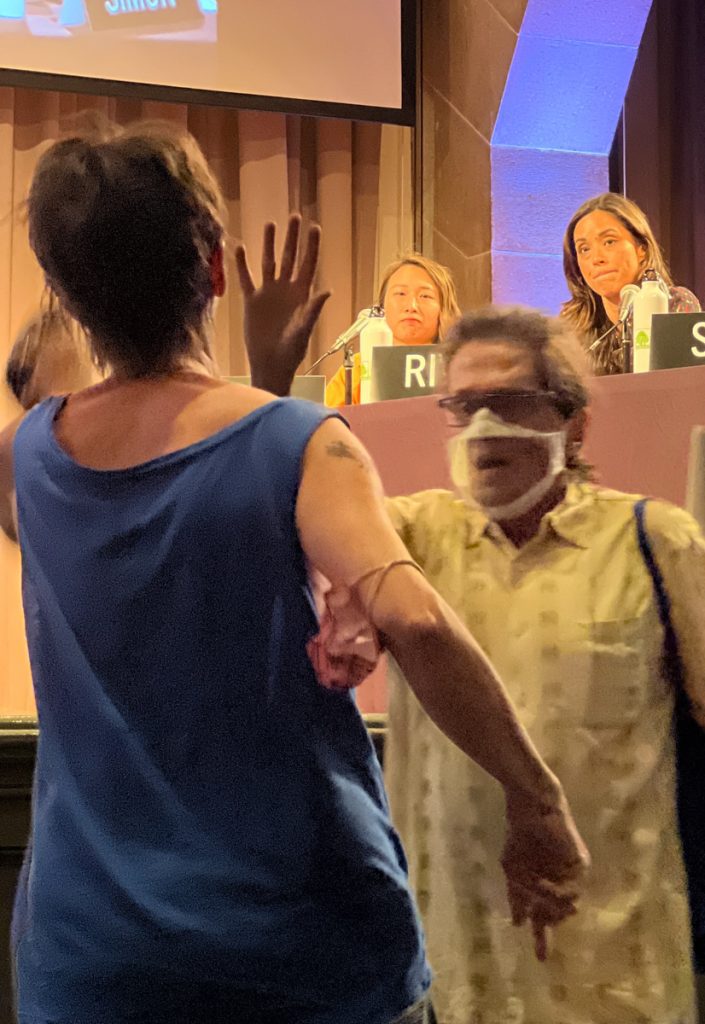
An East River Park activist confronted City Councilmember and District 10 congressional candidate Carlina Rivera, right, at a July 19 East Village forum on environmental issues. Rivera supporter Michael Schweinsburg of the 504 Democrats political club blocked the protester from getting any closer to the stage at The Cooper Union. PHOTO: PAT ARNOW
Whaddya Want Anyway?
What should the East Side Coastal Resiliency Plan look like? Posted Jan. 8, 2021:
Earlier visioning renderings from ESCR planning sessions with the community show marshes and wetlands with bridges and salt-water-resistant plantings. These are accommodations to sea level rise and storm surges. The parkland becomes a sponge that absorbs flood waters. Click here to read the article.
East River Park demolition is a failure of city officials
DECEMBER 5, 2021, THE VILLAGE SUN.
…Ever since the park’s complete destruction was announced in the fall of 2018, thousands of people, mostly from our Lower East Side and East Village, have earnestly and fervently been civically engaged to gain a flood plan that would retain and improve our park. We had good evidence that better, more truly resilient plans were possible that would gain us the same flood control. We uncovered more good evidence after many Freedom of Information requests and appeals.
It did not matter. No amount of reason and hearty civic engagement could move city officials. None of our testimonies, petitions, protests, e-mails and phone calls mattered. The politicians and city agencies were determined to push this fatally flawed plan down our throats and were just annoyed when we loudly choked… Click here to read the full op-ed.
Opinion: COVID-19 + Storm Surge = Catastrophe for the Lower East Side and East Village
May 14, 2020 in EV Grieve
…Demolishing more than half of the park will cause even more damage during this pandemic. “The majority of conditions that increase risk of death from COVID-19 are also affected by long-term exposure to air pollution,” reports The New York Times. The park eases the effects of our city’s pollution. If dust-raising construction begins during the pandemic, we can anticipate additional fatalities, because “even a small increase in exposure to fine particulate matter leads to a significant increase in the Covid-19 death rate.’ Click here to read the full op-ed
Local City Council Members Must Head Back to Drawing Board on East River Park Plan
November 13, 2019 in Gotham Gazette
Dear City Council Members Carlina Rivera, Margaret Chin, and Keith Powers:
You have indicated that on Thursday you will vote for the flood control plan that will demolish East River Park and rebuild it 8-10 feet higher over five years. This is a $1.45 billion, five-year project that will destroy more than a mile of coastline park that is vital to our neighborhood, the un-wealthy end of the Lower East Side and East Village. I urge you to change your vote to “no” on Nov. 14. Here’s why… Click here to read the full op-ed.
Why I became a park activist
In July 2001, shortly after we moved to the Lower East Side, the 1.2 mile promenade on the river was closed off because the pilings beneath it were damaged. There was a tall chain link fence blocking access. It remained that way for years. I wanted to know what was going on, so when I started writing regularly for Gotham Gazette, I took on the waterfront as my beat. What I found made me wary of the new project that would once again block the waterfront on the Lower East Side for many years–with no oversight.
East River Access From The Lower East Side
October 05, 2005, Gotham Gazette
The Lower East Side used to have spectacular access to the East River, thanks to the East River Park, built by master planner Robert Moses in 1939, and including a walkway built on bulkheads over the river, offering breathtaking views. But repairs and improvements were sporadic and piecemeal, and, in the summer of 2001, divers inspecting it found structural weakness in the retaining wall. Before the July 4 hordes could descend on the river to view fireworks, the city blocked off almost all of the walkway.
Click here to read it. Note: The construction wasn’t done until 2011.
Waterfront In Fits And Starts (And Stops)
September 27, 2006, Gotham Gazette
…Just north of the Manhattan Bridge, the park is still a mess, though rebuilding started on the walkway along the river last year. After contractors tore out the old promenade, soil from the muddy embankment began sliding into the river. The contractors placed bales of straw to stop the churned up mud from further erosion.
The work then stopped. Most of this summer, the construction site looked deserted, with heavy machinery sitting idle. Now, a parks department spokesman promises it will resume.
The delay did not attract much complaint from the neighborhood. The walkway has been closed since 2001, when it was deemed unsafe, so the community is used to living without it. Click here to read it.
The promenade completely reopened in 2011. Hurricane Sandy hit in 2012. The park reopened two days later. More than 260 trees were damaged. A thousand mature trees survived the saltwater inundation. Ten years we went without access to the waterfront. You can see why I became an activist when the park was threatened with closure and demolition again–this time to build a giant levee. This city is cruel to low-income neighborhoods, which ours mostly is.
Here’s another story from my time on the waterfront beat. It is still accurate since rainwater still drains right from the streets into the rivers:
Clean Enough To Swim In Again?
November 4, 2005, Gotham Gazette
If you happen to fall in to the New York Harbor, the Hudson, the East River, or Jamaica Bay, you need not fear bacterial infections or diseases from industrial pollution, according to a report from the city’s Department of Environmental Protection. Unless you fall in after a storm. Click here to read the article.
I also wrote a column about the neighborhood in a short-lived little print and online magazine, Grand Street News. Here is one of my columns, still relevant:
Life in the Bike Lane
July 2008, Grand Street News.
Biking around New York is my most reckless activity. People think I’m nuts to do it. I think I’m nuts to do it. As a grownup of the gray-haired persuasion, if I get in a minor accident, I’m going to limp for months. . .
Click here to read it.
The Politics of Photography
Photographs seemingly portray reality. They cannot not lie. But i’ve always been struck about what publications choose to show. What is their purpose? Would different images from the same event, inspire us to be horrified, to not support a war, for instance? That is what I examined for Extra!, the publication from Fairness and Accuracy in Reporting. These wars I discuss are past us, but the issues are meaningful:
Where Have All the Bodies Gone?
2005, Extra!
In a week in June when 15 GIs were killed in Iraq, the war pictures in The New York Times featured dazed Iraqis after a suicide bombing, a Marine patrolling, the twisted remains of a vehicle, wounded children, a civilian casualty in a morgue. No photographs featured American casualties–a typical absence in U.S. coverage of the war….
The images of war that appear today offer a marked contrast to the pictures of the dead and wounded from the Vietnam War, whose media coverage is credited with spurring protests through graphic images. …Click here to read the full story.
From Self-Censorship to Official Censorship
April 2007, Extra!
A letter in February to The New York Times (2/3/07) from the commander of the Multinational Corps in Iraq revealed new censorship regulations prohibiting portrayals of U.S. casualties in the media. The tightened rules have been in effect since May 2006, but no media outlet with embedded photographers reported on or objected to the censorship of images.Click here to read the story
Appalachia and The South
The Old South: For some black veterans, segregation lingers on
“When Doug Tyson rang the doorbell of American Legion Post 7 in Durham, N.C., last May, he was surprised that he didn’t get past the foyer. A disabled Vietnam veteran, he didn’t realize that this veterans’ service club was segregated. . . .” from a feature in These Times. Click here to read it.
Snake Handling
. . A retired truck driver, Carl Porter became inspired to handle snakes after he saw the practice at a church service. ‘I seen the Lord move on them. I wanted the Lord to move on me, and He did–told me to handle the serpent.‘ . . . from Southern Exposure. Click here to read it.
The Alternate ROOTS Dilemma: From Little Black Sambo to Son of White Man
The problem wasn’t that performer Ed Haggard took off his clothes during his one-person show, a section he called ‘I’m too white,’ and smeared his body with blue paint. It was what he said while he was doing it. He said that if he had more color, he might have a sense of rhythm, a love of nature. He painted his genitals and said if he had more color he might be more virile. . . .” article and analysis from Southern Exposure.” Click here to read the article, archived through the Community Arts Network.
Review of Gap Creek by Robert Morgan
“Morgan’s vision of Appalachian people is a romantic one, the flip side of familiar imaginings of the violence and evil, moonshine and madness in the mountains. . . .” from Now & Then and the Raleigh, N.C., News & Observer. Click here to read it.“
I wrote many book reviews for different publications, but I only include this one for now. I discussed the issues of trying to convey life in Appalachia with all its complexities–neither a place all about murder and mayhem or of calico and cornbread.
Interview with novelist Lee Smith
“In your books, you use a lot of folklore. For instance, one of your characters puts an axe under the bed to cut the pain of childbirth. I was wondering where you got this kind of thing.” “‘Well, I grew up in Grundy, Va., which is in Buchanan County in Southwest Virginia, and I was an only child, which means that I spent less time with other children and more time listening to old people. Although I was an only child, I had a real big family there. They were all real talkers.’ . . .”
from Conversations with Lee Smith, edited by Linda Tate, University Press of Mississippi. Click here to read it.
Here’s another piece in a discussion with the celebrated mountaineer author, trying to explore the nuances of a complicated culture without romanticizing the charms or scandalizing with some kind of backwardness and violence.
Now & Then Magazine
I wrote for and then edited the Appalachian magazine out of East Tennessee State University from 1984 to 1995. Each issue had a theme.
The issues from 1984-86 are downloadable from ETSU’s Digital Archives. https://dc.etsu.edu/now-then/
Black Appalachians
My interview with the guest editor of that issue, Ed Cabbell, is also published online here: https://www.appalachianplaces.org/post/from-the-vault-now-then
Homecoming 1986 (a celebration of Tennessee Communities)
Cherokees
Appalachian Music
Appalachian Women
and the introduction of the magazine, Vol. 1, No. 1, 1984